

Roofing estimating software
Bid more roofing work. Price each roof system.
Roof areas by system. Flashings, copings and gutters by the foot. Curbs and penetrations by count.
Kredna keeps each quantity tied to the roof plan it came from and prices it with your own costs.
Illustration on a made-up plan.
What a roofing takeoff carries.
Draw each roof area once, by system. For a sloped roof, give your item a pitch property and a formula for the slope, and the sloped area you buy by follows the plan area you draw.
| What you take off | How | Carried in |
|---|---|---|
| Roof area by system Membrane, shingles or metal panels. On a sloped roof, a formula on your item applies the slope factor from the pitch you set. | Area | SQ |
| Insulation boards under the membrane A part works out the boards from the roof area and the board size you set. | Area | EA (boards) |
| Tapered insulation and crickets | Area | SF |
| Base flashing at walls and curbs | Linear | LF |
| Copings From the roof plan, checked against the wall sections at the parapets. | Linear | LF |
| Gutters and downspouts Downspouts drawn by their length on the elevations. | Linear | LF |
| Drip edge on shingle roofs Drawn along the eaves and rakes, or a part of your shingle roof item. | Linear | LF |
| Curbs, pipe penetrations, hatches and walkway pads Curbs and penetrations from the mechanical and plumbing roof plans. | Count | EA |
Draw the roof once. Buy by the square.
Draw a roof plane on the roof plan with cutouts for the openings. Give a sloped roof its pitch as a property of your item, with a formula for the slope factor, and membrane, shingles and underlayment carry in squares with your waste on each.
Low-slope roofs are drawn the same way at their plan area. Keep each roof system as its own item, so the membrane roof and the shingle roof price apart.
Run the edges and the metal by the foot.
Base flashing at walls and curbs, copings on the parapets, gutters at the eaves and downspouts on the elevations are each drawn as runs. The building and wall sections show where each run starts and stops.
Count curbs and pipe penetrations from the mechanical and plumbing roof plans, so the flashing count matches the equipment on the roof.
Price the roof system as one assembly.
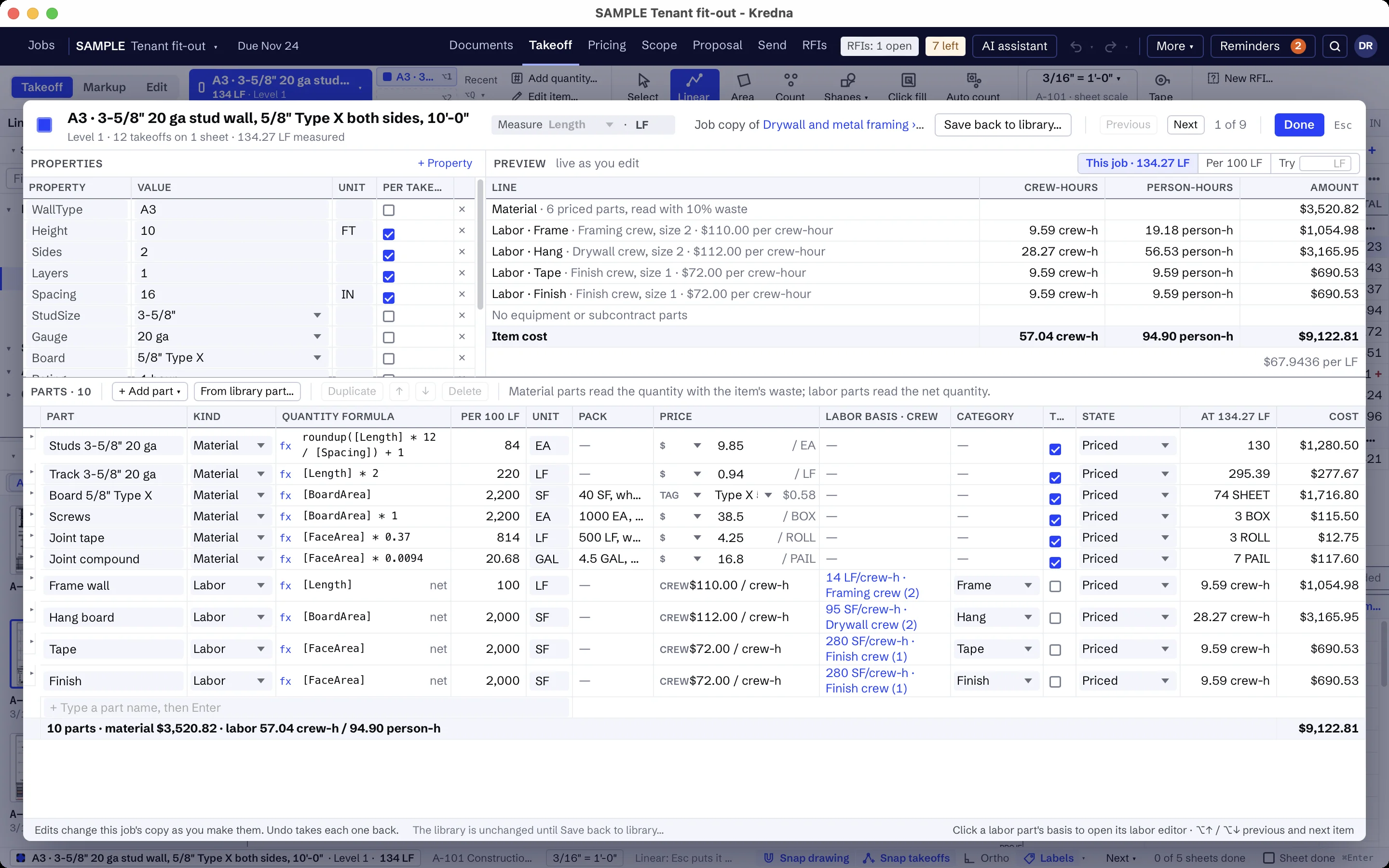
Make each roof system an item with its parts: membrane and insulation boards for a membrane roof, shingles, underlayment and drip edge for a shingle roof. Draw the roof and each part follows its formula.
Add the parts your systems use, such as cover board, fasteners, adhesive and labor in your own labor categories. Build it once in your library, and every job copies it when it is first used.
Check the roof when an addendum comes in.
Add the addendum in Documents. A revised roof plan with the same sheet number replaces the old one, the old sheet stays marked as replaced, and any takeoffs still on it are flagged for you to check.
Build your roofing items once.
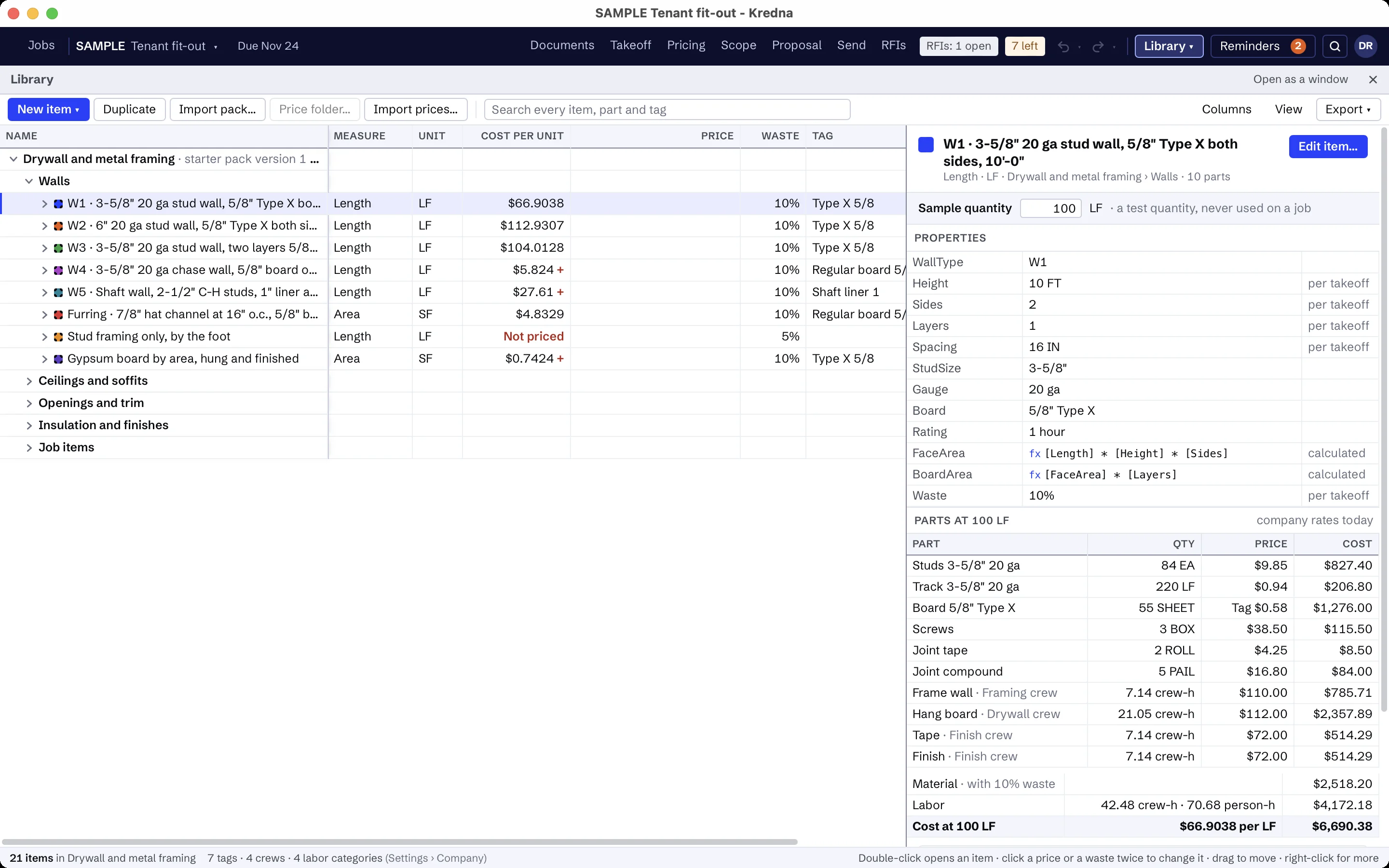
There is no roofing starter pack. Build your items in a Roofing folder in your library, for example in three parts: roof systems, flashings and sheet metal, and accessories. Items like these:
- Single-ply membrane roof, with membrane in squares and insulation boards
- Asphalt shingle roof, with shingles, underlayment and drip edge
- Metal roof panels and tapered insulation
- Base flashing, coping, gutter and downspout
- Curb flashing, pipe penetration flashing, roof hatch and walkway pad
- Your own clauses for the roofing and the manufacturer's warranty, a deck that is ready for roofing, and blocking, curbs and drain piping by others
The prices are yours to set. A part without a price shows as Missing, never as zero, and every total that includes it is marked incomplete until you price it.
Settle what is by others before the bid goes out.
Set up the scope assistant for roofing once: what to look for, which disciplines and spec sections to read, and what is usually by others. It reads the roof plans, sections and mechanical roof plans for roofing scope, highlights each reference so you can jump to it, and flags lines like these as usually another trade's. Its findings stay drafts until you accept them.
- Piping from the roof drains
- Wood blocking and nailers, unless listed
- Mechanical curbs and equipment supports
- Skylights, unless listed
- Lightning protection
AI findings need estimator review. Check quantities, costs and scope against the project documents before submitting a bid.
Moving from another takeoff tool?
Pick an item, measure on the sheet and watch the quantity total in the job tree. Build your items once in the library, and the takeoff, pricing and proposal all read the same job.
Roofing questions
Can Kredna take off a sloped roof in squares?
Which drawings does a roofing takeoff use?
How do I count curbs and penetrations?
What does the scope assistant look for on a roofing job?
Does it come with roofing prices?
Bring a roofing set you know.
See roof areas, flashings and the proposal come together on a job your company has bid.