

Insulation estimating software
Bid more insulation jobs. Price each wall type.
Batts by wall type and rating. Rigid board by the board. Spray foam by area and thickness. Safing at slab edges by the foot.
Kredna works each quantity out from what you draw and prices it with your own costs.
Illustration on a made-up plan.
What an insulation takeoff carries.
Walls are drawn by their length with a height, so you buy by the face. Ceilings, slabs and foam are drawn as areas.
| What you take off | How | Carried in |
|---|---|---|
| Batt insulation in stud walls Draw the wall and set its height. The rating is a property of the item. | Linear | SF |
| Sound batts in partitions Only the partitions the wall types call for. | Linear | SF |
| Rigid board at foundation walls A part works out boards from the wall's face and the board size you set. | Linear | EA (boards) |
| Rigid board under slabs | Area | EA (boards) |
| Batt insulation in ceilings | Area | SF |
| Blown-in insulation The depth is a property of the item. | Area | SF |
| Spray foam With the thickness as a property of the item. | Area | SF |
| Vapor retarder | Area | SF |
| Fire safing at slab edges | Linear | LF |
Take off walls by type. Buy by the face.
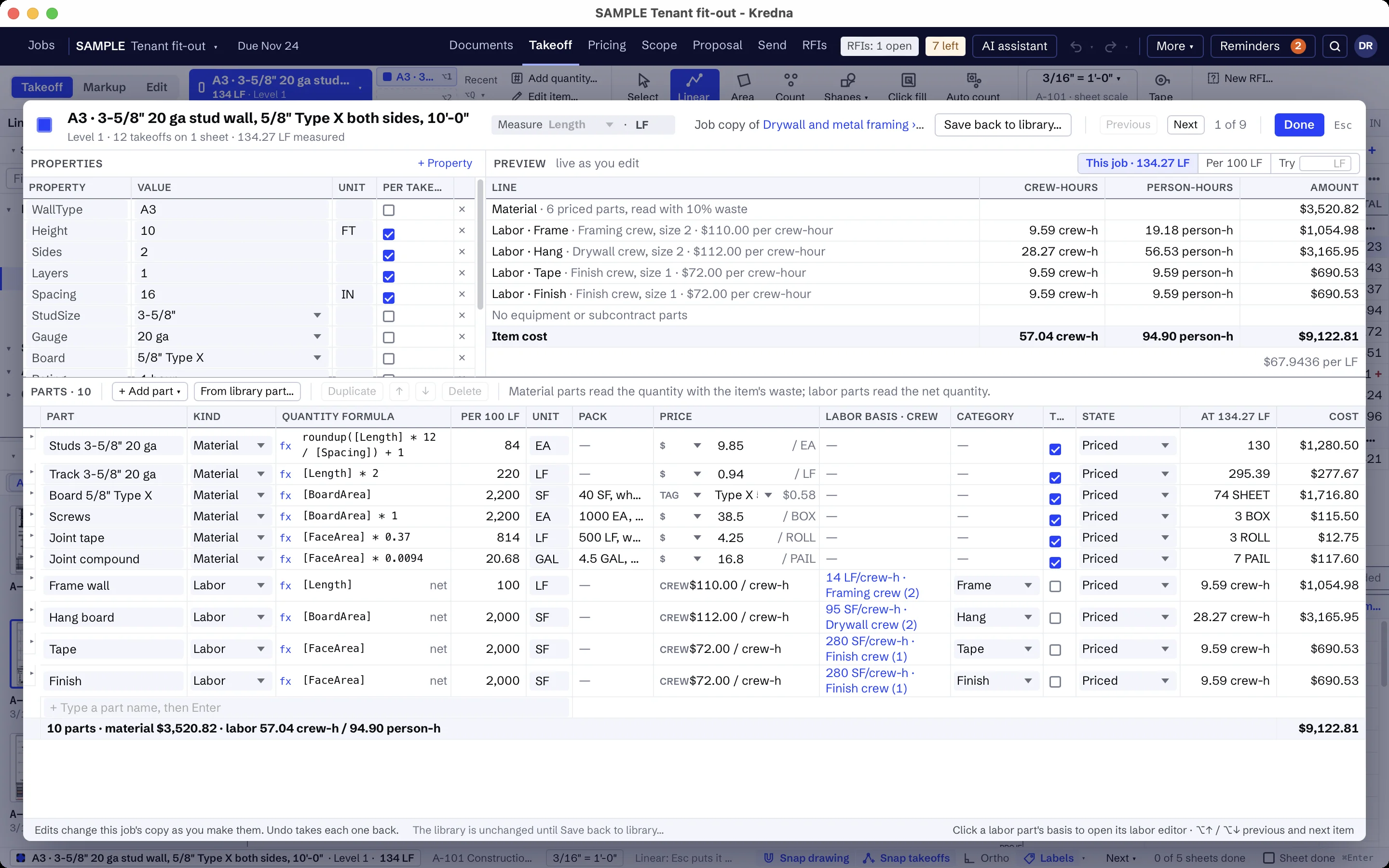
Draw each insulated wall along its length and set its height. A formula on your item carries the wall's face in square feet, so batts are bought by the area they fill.
Read the rating from the wall types and the partition schedule, and keep each rating as its own item, so R-13 and R-21 total apart.
Count rigid board from the area.
Rigid board at foundations and under slabs is bought by the board. Give your board item a part whose formula divides the area by the board's coverage and rounds up, with your waste applied once. Set the coverage for the board size you buy.
Keep foam and safing on their own items.
Spray foam is drawn by area with its thickness on the item. Fire safing is drawn as a run along each slab edge. Keep each floor or area in its own folder, and the price follows the drawings.
Build your insulation items once.
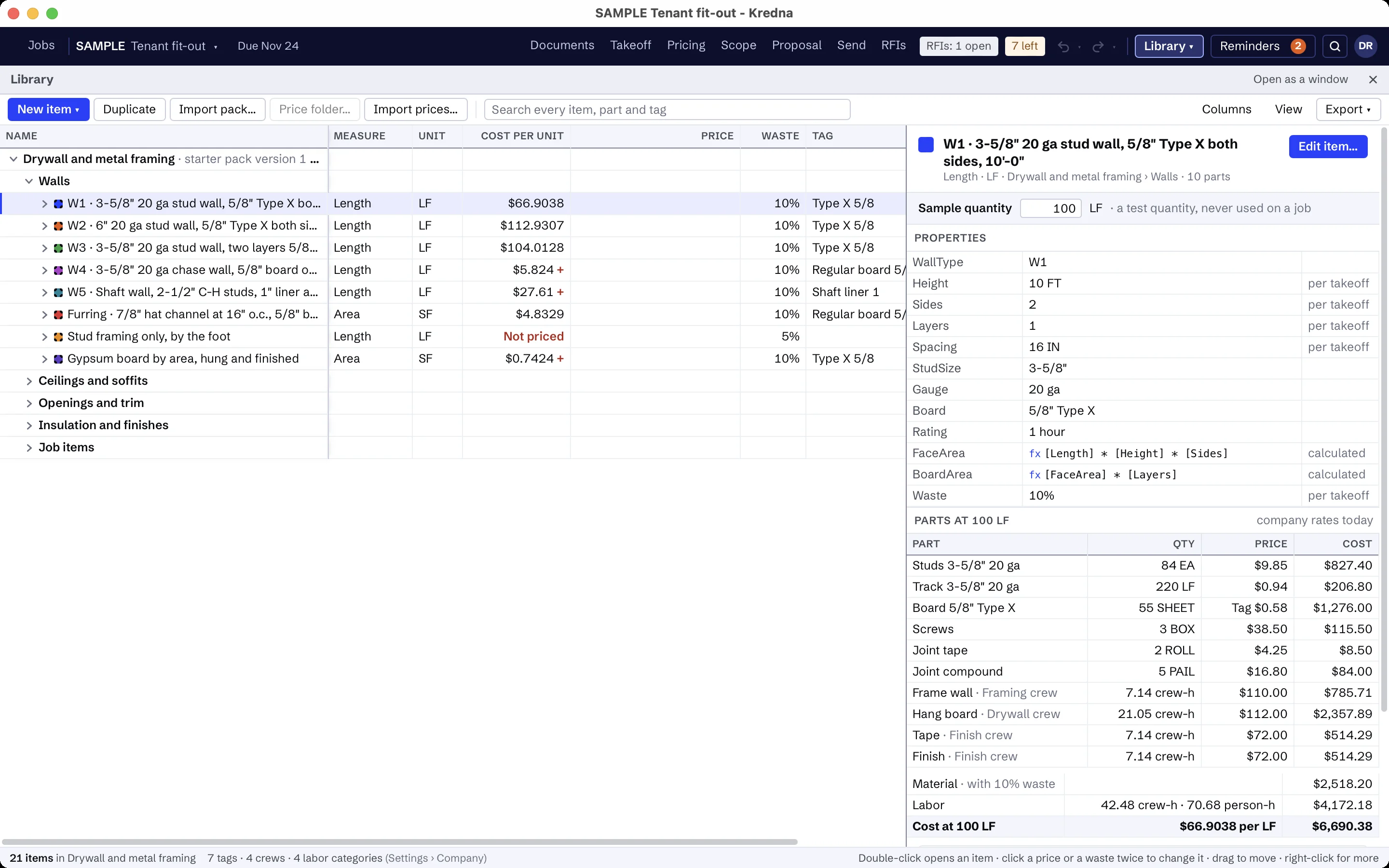
There is no insulation starter pack. Build your items in an Insulation folder in your library, for example in three parts: walls, ceilings and floors, and foam and safing. Items like these:
- Batt insulation in stud walls and sound batts in partitions, each with its rating and height
- Rigid board at foundation walls and under slabs, counted in boards
- Batt insulation in ceilings and blown-in insulation
- Vapor retarder
- Spray foam with its thickness, and fire safing at slab edges
- Your own clauses for the insulation and vapor retarders, cavities open when you start, and roof, pipe and duct insulation and firestopping by others
The prices are yours to set. A part without a price shows as Missing, never as zero, and every total that includes it is marked incomplete until you price it.
Settle what is by others before the bid goes out.
Set up the scope assistant for insulation once: what to look for, which disciplines and spec sections to read, and what is usually by others. It reads the wall types, sections, ceiling plans and energy compliance notes for insulation scope, highlights each reference so you can jump to it, and flags lines like these as usually another trade's. Its findings stay drafts until you accept them.
- Roof insulation that is part of the roofing system
- Pipe and duct insulation
- Insulation built into exterior wall panels and finish systems
- Firestopping at penetrations, unless listed
AI findings need estimator review. Check quantities, costs and scope against the project documents before submitting a bid.
Moving from another takeoff tool?
Pick an item, measure on the sheet and watch the quantity total in the job tree. Build your items once in the library, and the takeoff, pricing and proposal all read the same job.
Insulation questions
How do I take off batt insulation from the wall types?
Where do the required ratings come from?
Can Kredna count rigid insulation boards?
Is roof insulation in an insulation bid?
What does the scope assistant look for on an insulation job?
Bring an insulation set you know.
See walls, ceilings and the proposal come together on a job your company has bid.