

Landscape estimating software
Bid more landscape jobs. Price the plant schedule.
Count trees, shrubs and perennials on the planting plan and check them against the plant schedule. Take off sod, mulch, soil and irrigation from the same set.
Illustration on a made-up plan.
What you take off for landscaping.
Count plants by size on the planting plan, draw lawn and beds by area, and take off irrigation from its own plan. Beds carry their depths, so mulch and soil come out in cubic yards.
| What you take off | How | Carried in |
|---|---|---|
| Trees With the size from the plant schedule, such as 2" caliper. | Count | EA |
| Shrubs With the container size, such as 5 gal. | Count | EA |
| Perennials and ground cover | Count | EA |
| Sod and seed | Area | SF |
| Mulch Each bed's area times the mulch depth. | Volume | CY |
| Planting soil The bed area times the soil depth. Add settling as waste. | Volume | CY |
| Bed edging | Linear | LF |
| Spray and rotor heads | Count | EA |
| Drip line and lateral pipe | Linear | LF |
| Control valves and controllers | Count | EA |
Check the counts against the plant schedule.
Plant symbols repeat across a planting plan. With auto count, box one symbol and every match on that sheet is counted as the item you hold.
Compare your totals with the quantities on the plant schedule before you price them.
Beds by area, materials by depth.
Draw each bed once, with cutouts for the islands inside it. Mulch and planting soil come from the bed's area and the depth you set, in cubic yards. Edging comes from the runs you draw around it.
Irrigation from the same set.
Count heads, valves and controllers on the irrigation plan and draw drip and lateral runs. Keep each zone or area of the site in its own folder so each one is priced on its own.
Put the maintenance period in writing.
Keep clauses in your company list for plants, soil, mulch and lawn, and irrigation from the point of connection, with a clarification that maintenance and the plant warranty last for the period the notes give, and watering after that is the owner's.
Build your landscape items once.
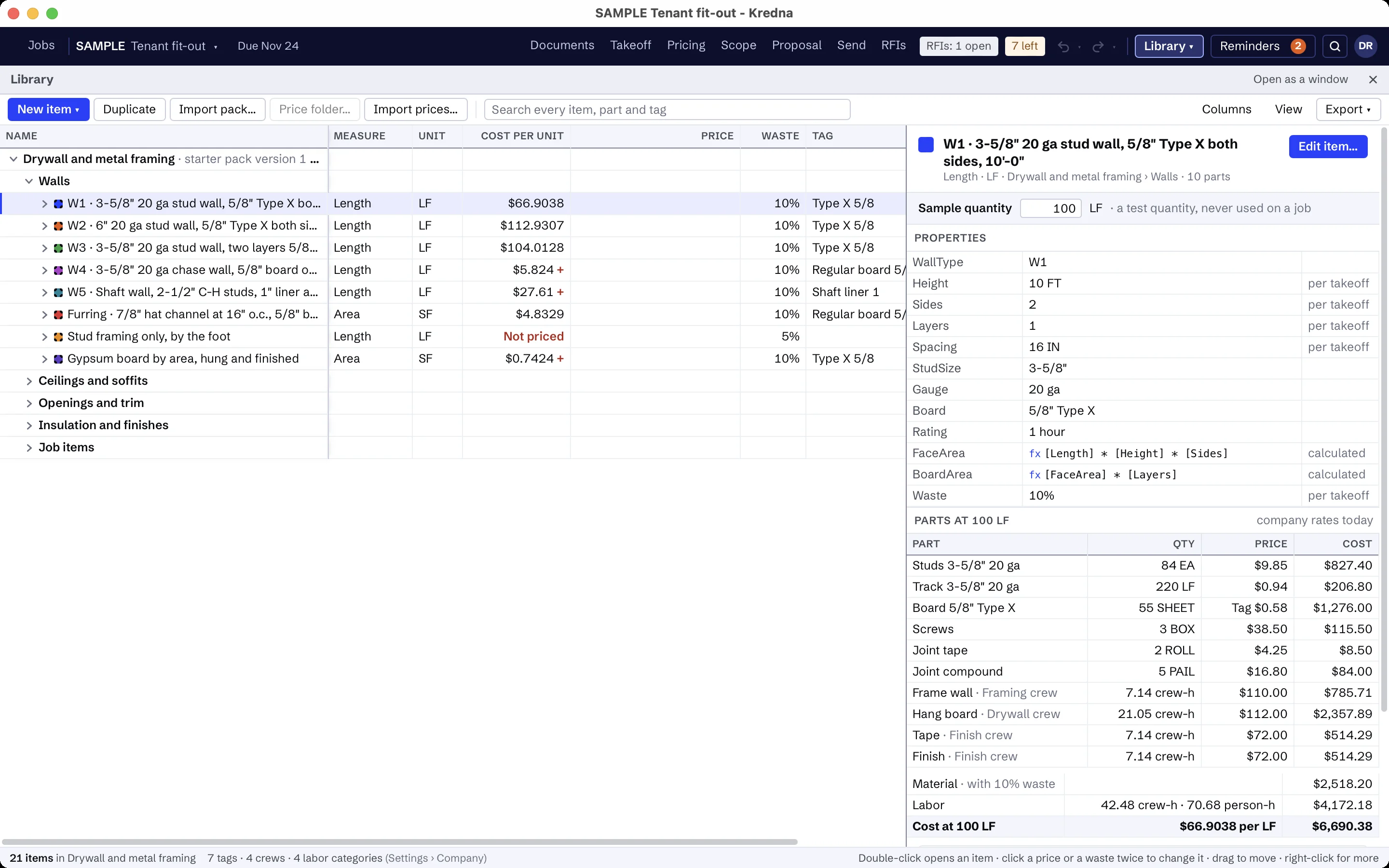
There is no landscaping starter pack. Build your items in your library, in folders for planting, lawn and beds, and irrigation. Give plant items their size from the schedule, and bed items a depth. Items like these:
- Tree, with its caliper size
- Shrub, with its container size
- Perennial or ground cover
- Sod
- Seed
- Mulch, with its depth
- Planting soil, with its depth
- Bed edging
- Spray or rotor head
- Drip line
- Lateral pipe
- Control valve
- Controller
- Your own clauses for planting, irrigation, rough grading, the water tap, controller power and maintenance
The prices are yours to set. A part without a price shows as Missing, never as zero, and every total that includes it is marked incomplete until you price it.
Landscape scope that is usually someone else's.
Set up the scope assistant for landscaping once: what to look for, which sheets and spec sections to read, and what is usually by others. It reads the planting and irrigation plans, plant schedule and landscape details, highlights each reference so you can jump to it, and flags lines like these as usually another trade's. Its findings stay drafts until you accept them.
- Rough grading
- The water tap, meter and backflow preventer, unless listed
- Power to the irrigation controller
- Paving, walls and site concrete
- Sleeves under paving, unless listed
AI findings need estimator review. Check quantities, costs and scope against the project documents before submitting a bid.
Moving from another takeoff tool?
Pick an item, measure on the sheet and watch the quantity total in the job tree. Build your items once in the library, and the takeoff, pricing and proposal all read the same job.
Landscaping and irrigation questions
Can I count plants by size?
Can Kredna count repeated plant symbols?
How do I carry mulch and soil in cubic yards?
Does it come with plant prices?
What does the scope assistant look for on landscape sheets?
Bring a landscape set you know.
See a planting and irrigation plan counted, measured and priced with your own crews.