

Tile estimating software
Bid more tile work. Price floors, walls and trim.
Floor tile is on the finish plan, wall tile heights are on the interior elevations, and the patterns are on the details.
Take off each surface in Kredna and the tile, setting material and grout come from its area, with the waste you set.
Illustration on a made-up plan.
What a tile takeoff covers.
Floors go in as areas, walls as runs with a tile height, trim by length and showers and thresholds by count.
| What you take off | How | Carried in |
|---|---|---|
| Porcelain floor tile Tile from the area plus waste, with setting material and grout by the bag. | Area | SF |
| Mosaic and stone floor tile | Area | SF |
| Ceramic wall tile Drawn along the wall; a tile height turns the length into area. | Linear | LF, SF |
| Tile base | Linear | LF |
| Bullnose and trim pieces | Linear | LF |
| Edge strips | Linear | LF |
| Thresholds | Count | EA |
| Shower pans with waterproofing | Count | EA |
| Waterproofing and crack isolation membranes | Area | SF |
Tile, setting material and grout from the area.
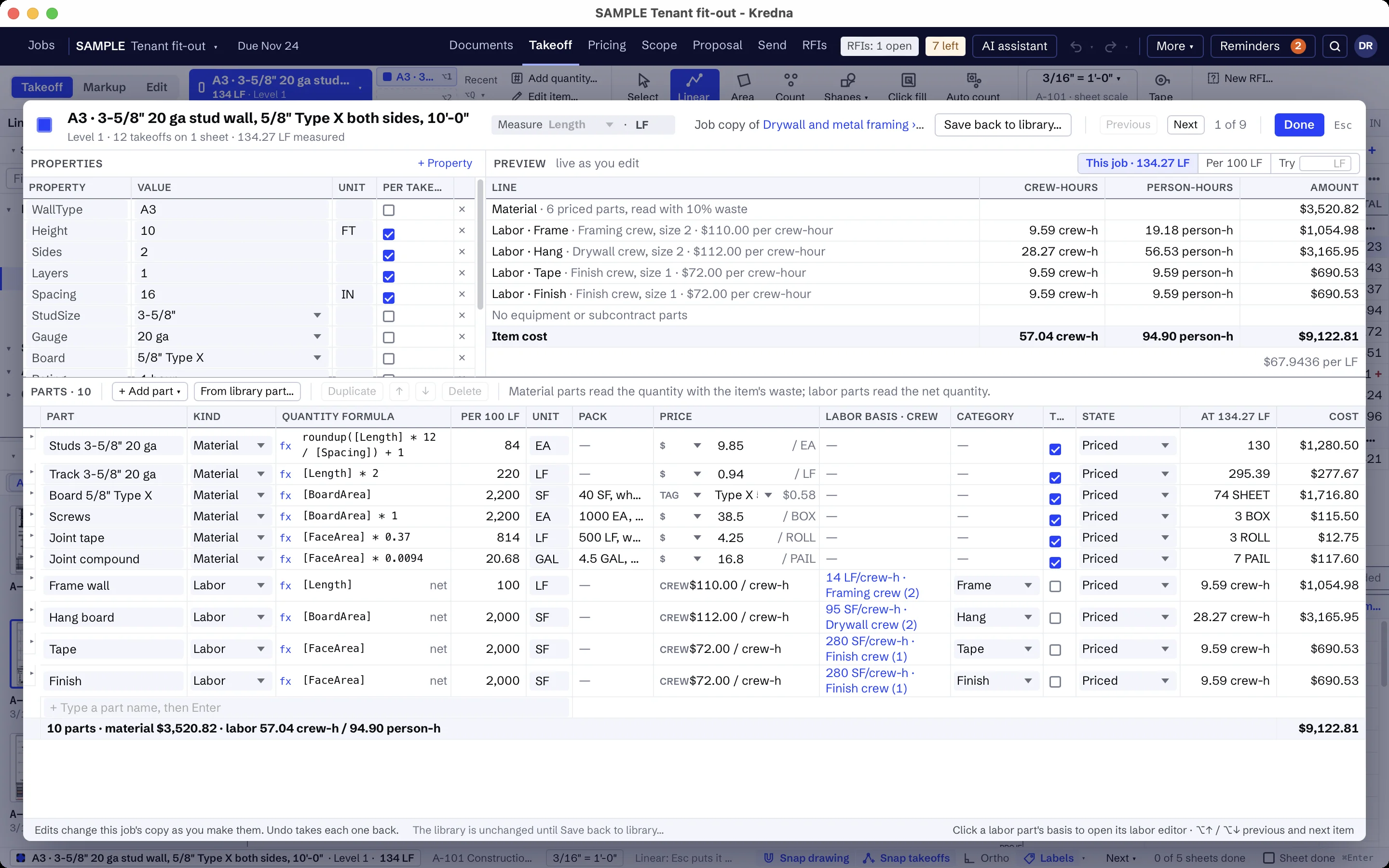
Build your tile items once: the tile part carries the area plus the waste you set for the pattern, and setting material and grout parts buy whole bags from the area over the coverage you set for your trowel, tile and joint size.
Wall tile from the elevations.
Draw each tiled wall along its length on the enlarged plan or the elevation, with a height property from a wainscot to a full-height shower wall. A formula works out the face area, and a selected run can carry its own height.
Give each enlarged plan and elevation its own scale region, even where several share one sheet. Each takeoff stays on the sheet it was drawn on.
Membranes, pans and trim on their own lines.
Shower pans by count, waterproofing and crack isolation membranes by area, base and trim by length, thresholds by count. Each one is its own item in the job tree, priced with your costs, so Pricing shows where the number comes from.
Say what the tile price covers.
Keep your tile inclusions, exclusions and clarifications in the company clause list: tile, setting materials, grout and trim of the types shown, membranes where shown, backer board, plumbing fixtures and sealing stone and grout by others unless listed. Scope brings them onto each job.
Items a tile company builds once.
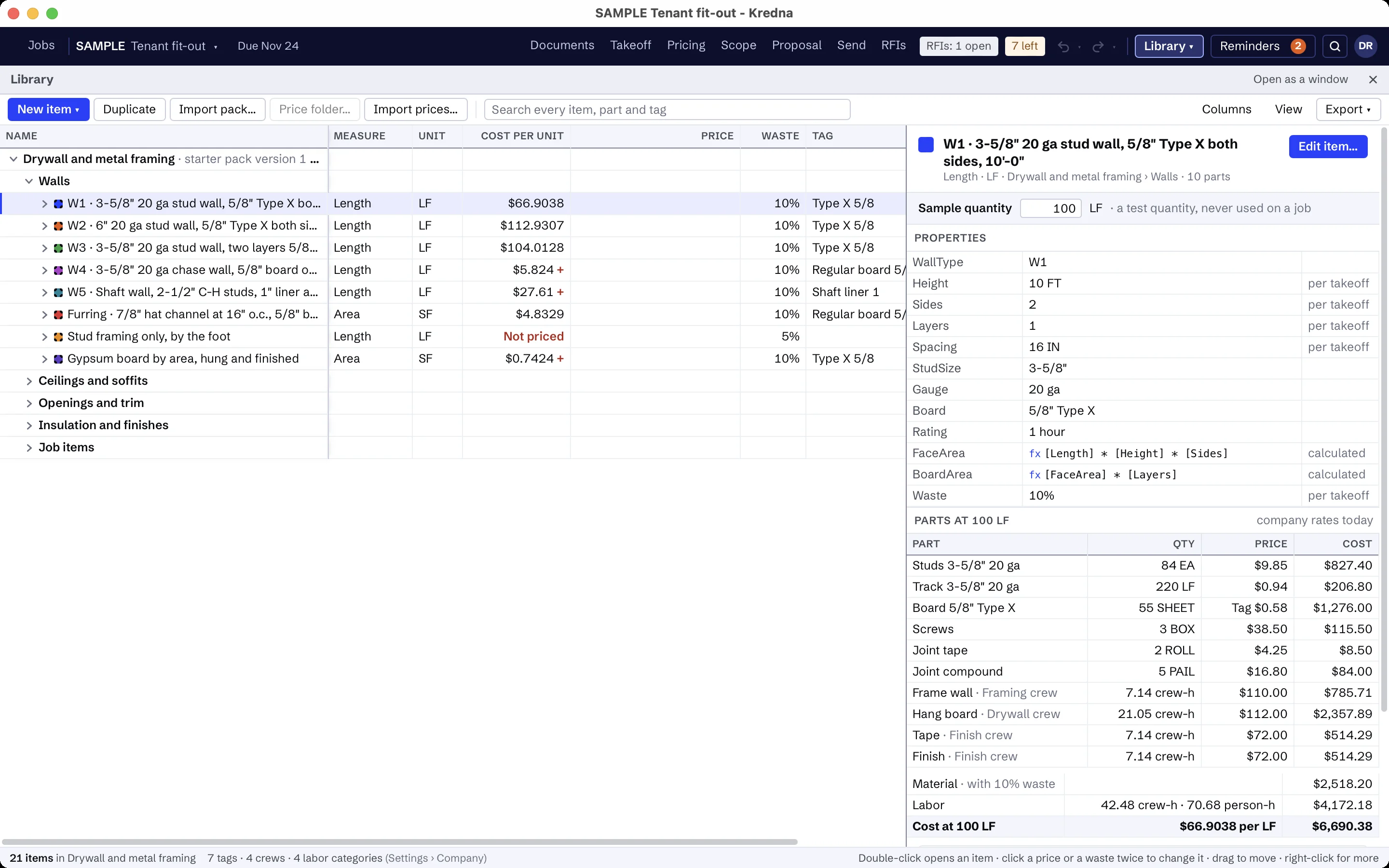
Build your tile items in the library once, with their parts and formulas, and each job copies the ones it uses. Examples of what tile companies build:
- Porcelain floor tile, with tile, setting material and grout as parts
- Mosaic floor tile and stone tile
- Ceramic wall tile, with a tile height
- Tile base, bullnose and trim pieces, and edge strip
- Threshold, and shower pan with waterproofing
- Waterproofing and crack isolation membranes
- Your tile inclusions, exclusions and clarifications
The prices are yours to set. A part without a price shows as Missing, never as zero, and every total that includes it is marked incomplete until you price it.
Tile scope that is usually someone else's.
Write the assistant's setup for tile once: what to look for, the sheets and spec sections to read, and what is usually by others. It then reads the enlarged plans, interior elevations and finish schedule you choose, such as wall tile heights and membranes, highlights each place for you to jump to, and flags lines like these as usually another trade's. Findings stay drafts until you accept them.
- The wall board behind the tile unless listed
- Plumbing fixtures and floor drains
- Countertops
- Resilient and carpet flooring
AI findings need estimator review. Check quantities, costs and scope against the project documents before submitting a bid.
Moving from another takeoff tool?
Pick an item, measure on the sheet and watch the quantity total in the job tree. Build your items once in the library, and the takeoff, pricing and proposal all read the same job.
Tile questions
How does Kredna add tile waste?
Can I work out thinset and grout?
Can I take off wall tile from the elevations?
What if I haven't priced a part?
Does the AI help with tile?
Bring a tile set you know.
See how the floors, the walls and the proposal fit together on a job your company bids.